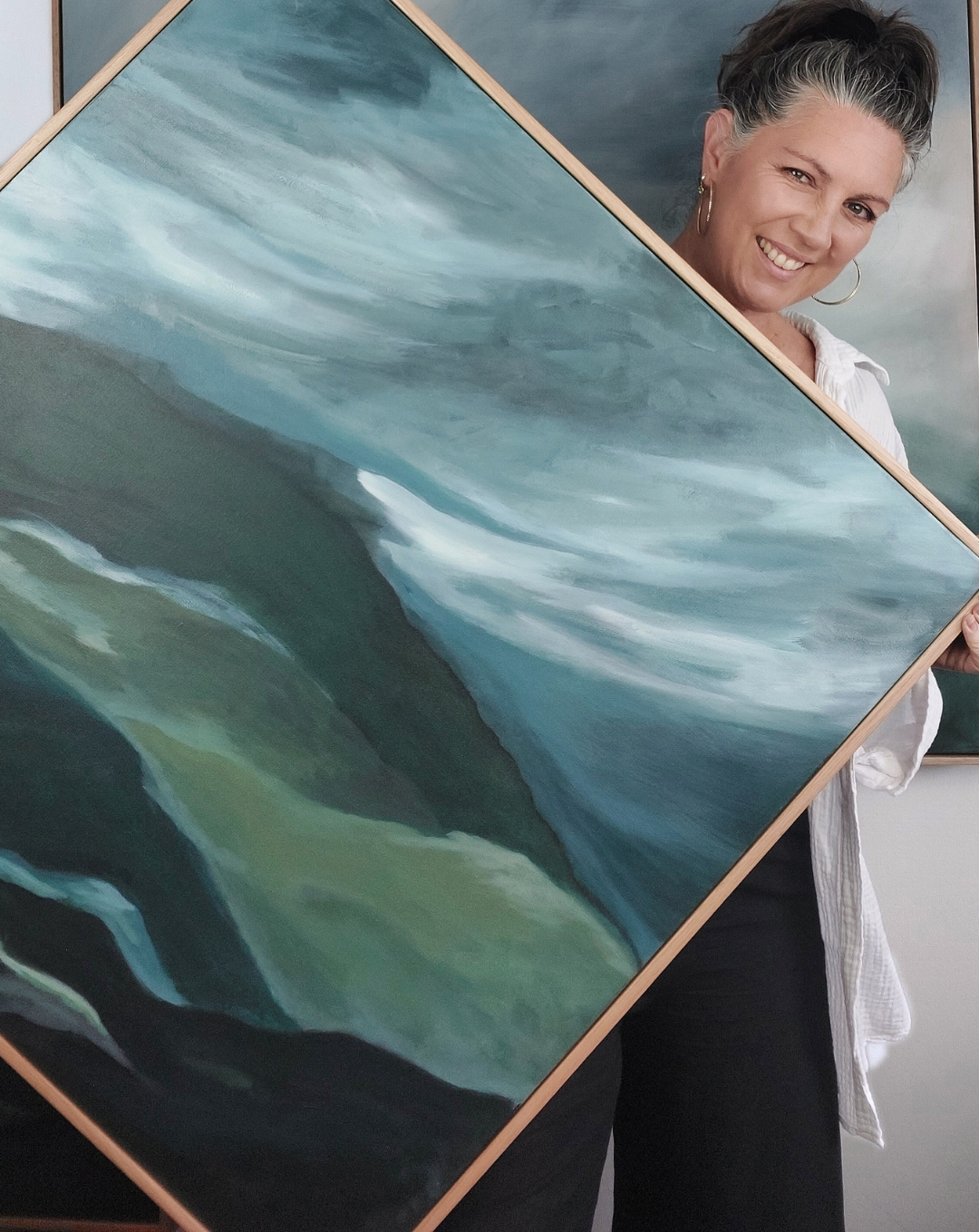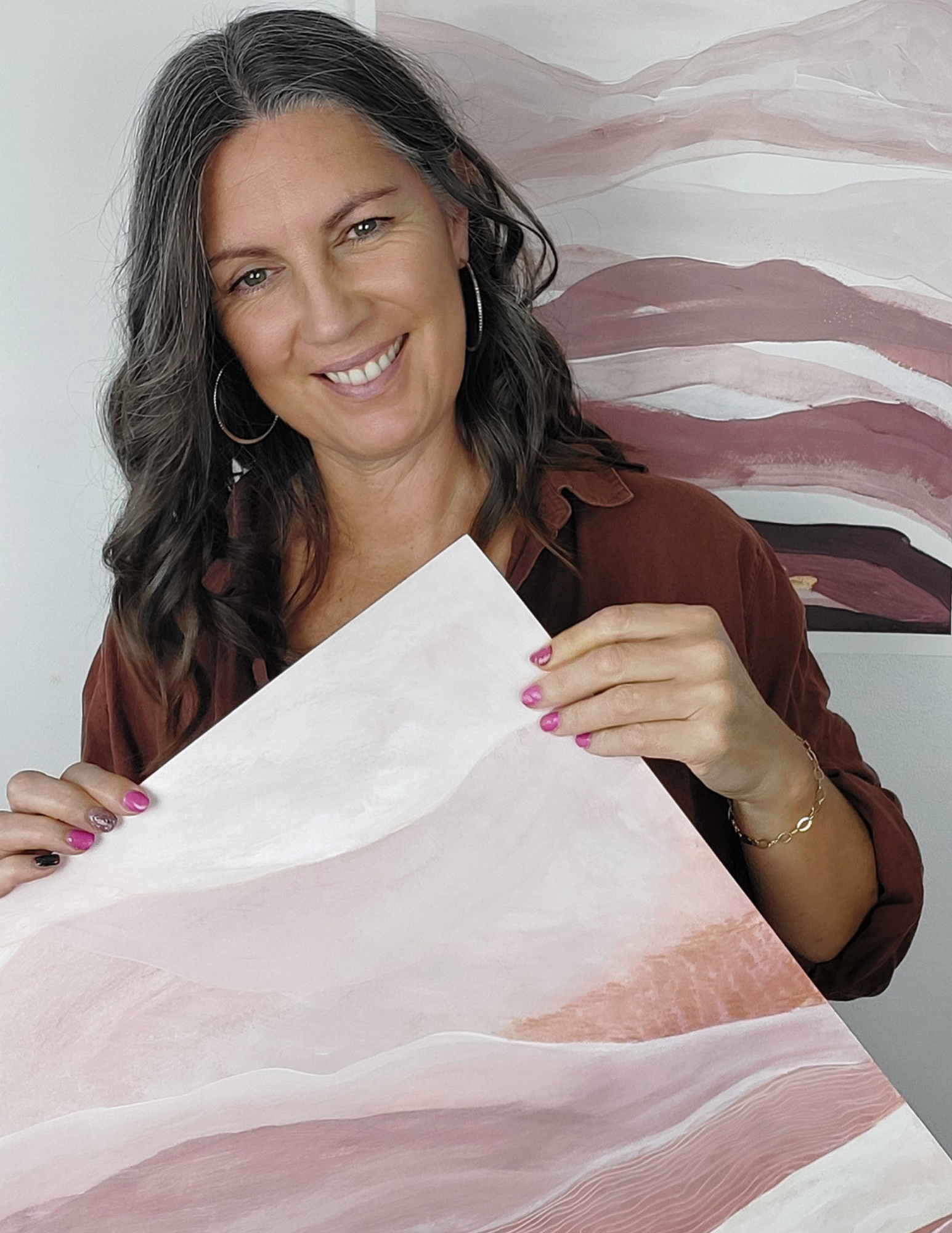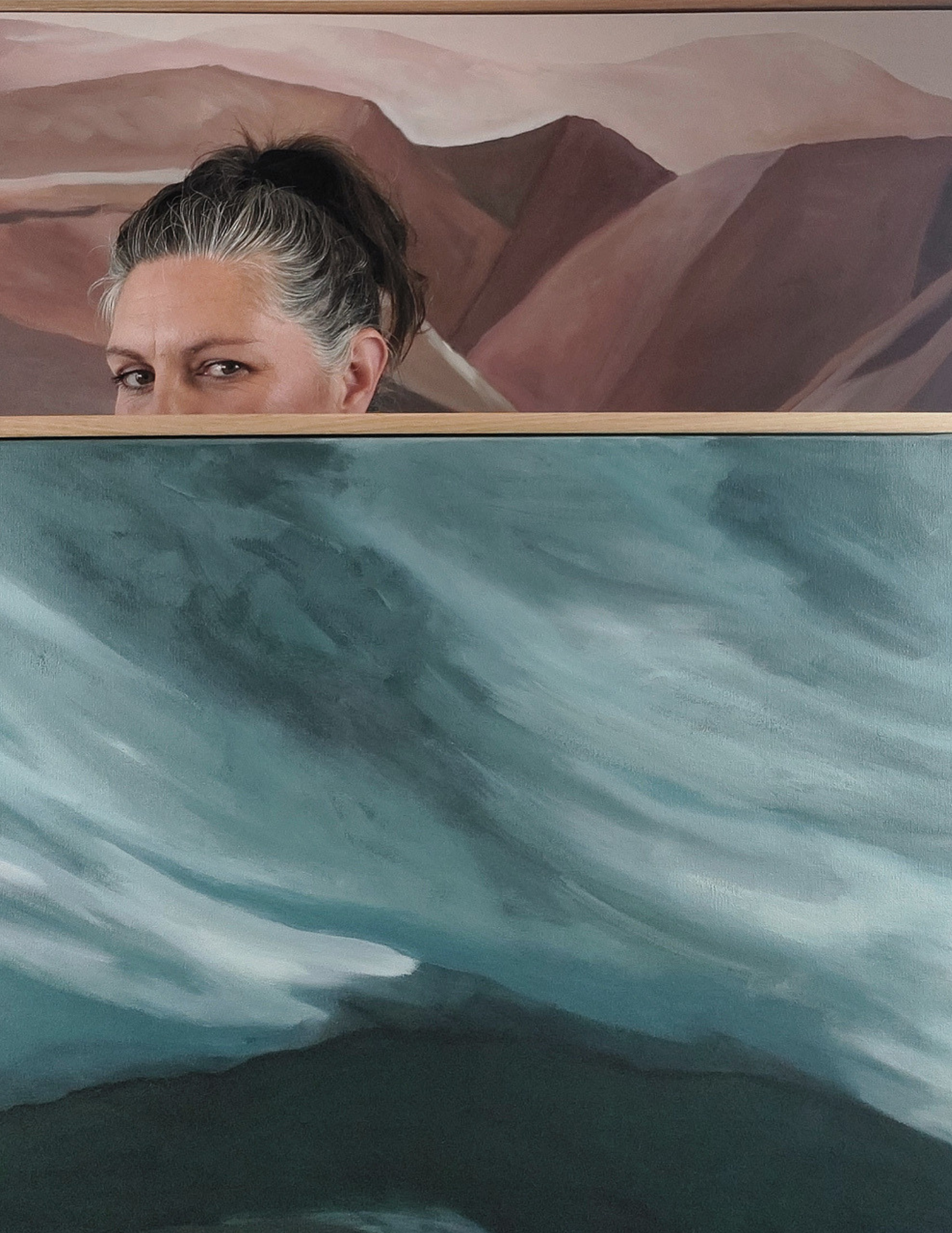
How a Painting Begins
An artist Q&A with Leanne Aroha Mulder about creative instinct, collecting visual memories, the excitement of a blank canvas, and knowing when it's finally time to stop.
Where does a painting begin for you?
It begins as a feeling.
I'll lie in bed and have this bubbling-up feeling inside me that there's so much that wants to come out and I need to paint it.
It feels like I'm full of visions. My head gets puffy with clouds.
It can build over a few weeks until I almost feel it physically. My body starts to vibrate in a certain way and I become a little frenetic. It's like something inside me is saying, I've got paintings I need to get out. I need to get these onto paper. I need to get these onto a board.
The first spark isn't necessarily a colour or a particular image.
It's the feeling that there are paintings in me.
What are you collecting before you paint?
So many things.
I think of them almost as screenshots in my brain.
I'm constantly noticing colour and light. Light on the ocean. Light on a pebble. Light on a leaf. Light shining through water onto something underneath.
Then there are the enormous things. Driving north and seeing a huge vista, watching rain coming towards us or mist sitting in the hills in the distance.
I'm always trying to capture the colours I see, too. I'll look at something and think, Is that grey? What kind of grey is it? Then I'll start separating it in my head — grey, dark grey, light grey, another tonal grey — trying to remember exactly what I saw.
And texture absolutely thrills me.
There's a little reserve on one of the walks near where I live, and I can become completely absorbed by the bark of a tree or a tiny section of forest. You could take one square metre of forest and there is an entire world within it. The textures, colours, depth, changing light — even the smell.
I'm collecting all of that, all the time.
How do you feel about a blank canvas?
Oh my gosh, I love it.
The blank canvas is incredibly exciting to me. Even going to get a new canvas is exciting. Unwrapping it, bringing it home and hanging that completely blank surface on the wall.
I look at it and think, Oh my God. I'm so ready for this.
I've never really been frightened of a blank canvas. To me, it feels like possibility.
Do you know what the finished painting is going to look like?
No, not usually.
I'm very tunnel-visioned when I'm painting, but not necessarily about the final product. It's more that I have this feeling that whatever is inside me needs to come out, so I let it.
I've actually always painted like that.
Years ago, I could get frustrated if a painting didn't turn out because I felt as though I'd wasted an entire canvas. I don't feel that way anymore.
Now I understand that I can come back and paint over it. Often whatever is already on the canvas becomes part of the background of the finished work. I can use it in another way.
Nothing is really wasted.
Do you paint slowly or quickly?
Sometimes incredibly quickly.
I tend to paint in big spurts. I might begin on a Friday night and then paint throughout the weekend until Sunday.
Once I start, I can become completely absorbed in it. Some days I paint very fast because it feels as though my body needs to move and get it out of my system.
Part of that probably comes from the way painting currently fits into my life. I have a full-time job and I'm a mum, so my painting time has to fit into the gaps. I'm not standing in the studio every day putting pressure on myself to produce something.
Maybe if I had to paint every day, the blank canvas could become intimidating.
Right now, it's the opposite.
I have more art in me than I have time to capture.
What's the first thing you put onto the canvas?
The first mark is actually a second base coat — the undercoat that sits underneath the painting.
That colour is quite important because it establishes the underlying feeling of the work. A bright pink underneath a painting creates a completely different sensation from a green or a brown.
I don't have a formula. I choose what feels right at the time and see where it goes.
But I've also been painting for years, so there's experience underneath that instinct. I've painted enough to understand what different undercoat colours will do to the layers that eventually sit above them.
With a landscape, I might begin with something deeper underneath to create depth, but you never completely know where it's going to end up.
Sometimes almost all of that first colour gets painted over.
But I like leaving hints of it coming through.
Does the painting ever start to tell you what it needs?
Yes. I respond very much to what's already there.
Sometimes I'll reach the end of a huge energetic explosion of painting and simply know I've had enough for the day. I can also see that certain things aren't finished — but I know they're the beginning of something.
Then, as I keep working, I'll reach another stage where I'll look at it and think, Oh yeah. You're getting really close.
One of the most important things I do at that point is step back.
When you're painting, your face can be only inches away from the canvas. You're completely inside the detail.
So I physically walk across the room. Sometimes I'll take the painting into another room and stand five metres away from it.
From there I can suddenly see the totality of the composition. I can see its balance and, more importantly, how the whole painting feels.
Stepping back is really important.
How do you know when a painting is finished?
It's a total feeling.
I sometimes ask my husband what he thinks, and I've become very good at reading his first one- or two-second reaction. There's something quite useful about that immediate response before someone has had time to think about what they're supposed to say.
I'll take his opinion on board, but ultimately I still have to finish the painting in the way that feels right to me.
And sometimes I don't agree at all.
I'll put the painting back on the wall or onto a shelf and leave it there until it wants to be finished.
That's something I've learned over time. There can be a difference between a painting being finished and me simply being finished with it for now.
It might need to sit.
But when a painting truly is finished, I know.
I step back. I look at it.
And I just go, Yep.
Then I stop.

Written by Leanne Mulder